

TYPES OF
INDUSTRIAL PUMPS
A pump is a device that moves fluids, or sometimes slurries, by mechanical action, typically converted from electrical energy into hydraulic energy. Pumps can be classified into three major groups according to the method they use to move the fluid: direct lift, displacement, and gravity pumps. Pumps operate by some mechanism (typically reciprocating or rotary), and consume energy to perform mechanical work moving the fluid. Pumps operate via many energy sources, including manual operation, electricity, engines, or wind power, and come in many sizes, from microscopic for use in medical applications, to large industrial pumps.
Mechanical pumps serve in a wide range of applications such as pumping water from wells, aquarium filtering, pond filtering and aeration, in the car industry for water-cooling and fuel injection, in the energy industry for oil and natural gas or for operating cooling towers and other components of heating, ventilation and air conditioning systems. In the medical industry, pumps are used for biochemical processes in developing and manufacturing medicine, and as artificial replacements for body parts, in particular the artificial heart and penile prosthesis. When a casing contains only one revolving impeller, it is called a single-stage pump. When a casing contains two or more revolving impellers, it is called a double- or multi-stage pump.
Pumps can be classified by their method of displacement into positive-displacement pumps, impulse pumps, velocity pumps, gravity pumps, steam pumps and valveless pumps.
There are three basic types of pumps:
I) Positive-Displacement
II) Centrifugal
III) Axial-Flow
I) Positive Displacement Pumps
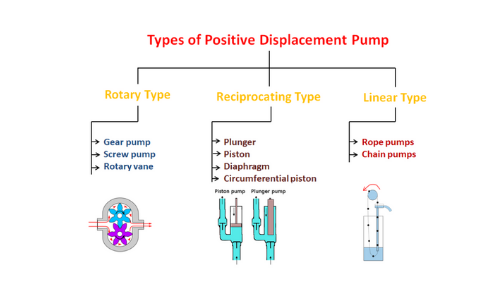
A positive-displacement pump makes a fluid move by trapping a fixed amount and forcing (displacing) that trapped volume into the discharge pipe. Positive-displacement pumps can theoretically produce the same flow at a given speed (rpm) no matter what the discharge pressure. Thus, positive-displacement pumps are constant flow machines. However, a slight increase in internal leakage as the pressure increases prevents a truly constant flow rate.
A positive-displacement pump can be further classified according to the mechanism used to move the fluid:
•Rotary-type positive displacement: internal or external gear pump, screw pump, lobe pump, shuttle block, flexible vane or sliding vane, circumferential piston, flexible impeller, helical twisted roots or liquid-ring pumps
•Reciprocating-type positive displacement: piston pumps, plunger pumps or diaphragm pumps
•Linear-type positive displacement: rope pumps and chain pumps
II) Centrifugal Pumps
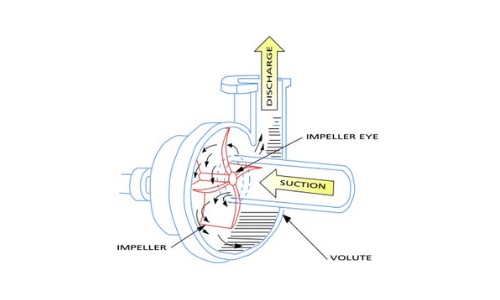
The Centrifugal Pumps are used to transport fluids by the conversion of rotational kinetic energy to the hydrodynamic energy of the fluid flow. The rotational energy typically comes from an engine or electric motor. They are a sub-class of dynamic axisymmetric work-absorbing turbomachinery. The fluid enters the pump impeller along or near to the rotating axis and is accelerated by the impeller, flowing radially outward into a diffuser or volute chamber (casing), from which it exits.
•Vertical Centrifugal Pumps are also referred to as cantilever pumps. They utilize a unique shaft and bearing support configuration that allows the volute to hang in the sump while the bearings are outside the sump. This style of pump uses no stuffing box to seal the shaft but instead utilizes a “throttle bushing”. A common application for this style of pump is in a parts washer.
•Froth Pumps is generated to separate the rich minerals or bitumen from the sand and clays. Froth contains air that tends to block conventional pumps and cause loss of prime. Over history, industry has developed different ways to deal with this problem. In the pulp and paper industry holes are drilled in the impeller. Air escapes to the back of the impeller and a special expeller discharges the air back to the suction tank. The impeller may also feature special small vanes between the primary vanes called split vanes or secondary vanes. Some pumps may feature a large eye, an inducer or recirculation of pressurized froth from the pump discharge back to the suction to break the bubbles
•Multistage Centrifugal Pumps are centrifugal pumps containing two or more impellers. The impellers may be mounted on the same shaft or on different shafts. At each stage, the fluid is directed to the center before making its way to the discharge on the outer diameter.
•Regenerative Turbine Pumps are non-positive displacement pumps that are compact and can operate at high pressure. The pump suction side is at the perimeter of the vanes and next to the pressure side of the pump. The pump has an impeller with a number of vanes or paddles which spins in a cavity. Fluid spirals repeatedly from a vane into the cavity and back to the next vane. Pressure builds with each spiral. Operation is similar to a regenerative blower.
III) Axial-Flow Pumps

An axial-flow pump, or AFP, is a common type of pump that essentially consists of a propeller (an axial impeller) in a pipe. The propeller can be driven directly by a sealed motor in the pipe or by electric motor or petrol/diesel engines mounted to the pipe from the outside or by a right-angle drive shaft that pierces the pipe. Fluid particles, in course of their flow through the pump, do not change their radial locations since the change in radius at the entry (called ‘suction’) and the exit (called ‘discharge’) of the pump is very small. Hence the name “axial” pump.
An axial flow pump has a propeller-type of impeller running in a casing. The pressure in an axial flow pump is developed by the flow of liquid over the blades of impeller. The fluid is pushed in a direction parallel to the shaft of the impeller, that is, fluid particles, in course of their flow through the pump, do not change their radial locations. It allows the fluid to enter the impeller axially and discharge the fluid nearly axially. The propeller of an axial flow pump is driven by a motor.
The main advantage of an axial flow pump is that it has a relatively high discharge (flow rate) at a relatively low head (vertical distance). For example, it can pump up to 3 times more water and other fluids at lifts of less than 4 meters as compared to the more common radial-flow or centrifugal pump. It also can easily be adjusted to run at peak efficiency at low-flow/high-pressure and high-flow/low-pressure by changing the pitch on the propeller (some models only). The effect of turning of the fluid is not too severe in an axial pump and the length of the impeller blades is also short. This leads to lower hydrodynamic losses and higher stage efficiencies. These pumps have the smallest of the dimensions among many of the conventional pumps and are more suited for low heads and higher discharges.
After learning about the types of Industrial pumps, we recommend you selecting the appropriate pump, according to the technical specifications and requirements of your project.
WE ARE HERE TO HELP YOU
If you want tips or more info about the proper pump for your project, CONTACT US!
Recent Comments